Resources

Showing posts with label Roku (ROKU). Show all posts

Monday, May 11, 2020

Themes From Roku and Trade Desk Earnings

Roku and Trade Desk ("TTD") both reported earnings last week. 1Q results were strong but 2Q does not sound that great, especially for TTD which mentioned that during the last 10 days of April, "total spend improved to a negative high teens year-over-year decline."

But this post is not about near term puts and takes. I want to outline the big picture themes that stood out to me.


TV Upfronts

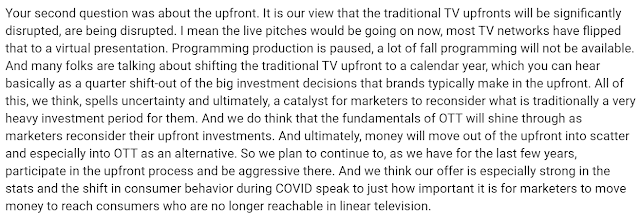
Both TTD and Roku talked about how failure of traditional TV "upfront" season can accelerate movement toward connected TV ("CTV").

Here's Roku in its 1Q20 call:


Here's TTD:

"Often, the majority of TV ads are sold in the upfront process. The upfronts are usually done in late April and early May, and those events are largely suspended this year."

"For advertisers, this can be liberating. I hear it from brands and agencies every day. For them, the upfronts are a bit of a burden. They're asked to commit billions of dollars to content they don't know that much about and chasing audiences that they can't measure quite as well as anywhere else. Now they have the freedom to be more deliberate, agile and data-driven in their TV ad investments."

That's an interesting point about advertisers not liking the upfront format. It reminds me of Bruce Greenwald's views of upfronts - as a scheme for media to collaborate against advertisers. 

"Behind the glitz is a highly successful, closely coordinated system to ensure the highest prices possible for advertising with the least incentive among networks to undercut one another."

"The up-front season occurs in the context of a general industry agreement on capacity developed under the guise of a public interest code of conduct to 'protect' viewers from too many advertisements...With the limited number of minutes available for sale preagreed, the tight time frames of the season make it relatively difficult for advertisers to successfully pit the networks against one another on price."
      - from "Curse of the Mogul" by Seave, Greenwald, and Knee


So traditional media is already declining, and now its implicitly anti-competitive/collaboration scheme is being exposed.

The question is what replaces the upfronts? Will there be another process that protects the bargaining power of publishers? Or does the leverage shift to ad buyers from now on?


CTV Now Exceeds Linear TV in Reach


I find it hard to believe but this is what TTD is saying. Jeff Green actually goes further and compares TTD alone to traditional TV!

"As I said, according to eMarketer, our total U.S. households with cable would fall below 82.9 million this year. Our research suggests it could be below 80 million. This year, we expect to reach well over 80 million households via CTV in the United States."

"This is an important point. The Trade Desk is the largest aggregator of CTV ad impressions across every major content provider, and that massive scale is a great leading indicator of future spend on our platform. All of this means that in 2020, The Trade Desk will likely surpass traditional TV in reach capabilities for the first time in our history. We're already seeing this shift as brands strategize on our platform."

Of course, larger reach does not mean larger monetization, but things are certainly looking bright for CTV. 

I don't like how TTD use the word "aggregator" to describe itself. It may be technically true, but broadcasting your ambition this way will likely make your clients wary and try to reign in your dominant position.


Strategic Role of Roku Channel, and CTV Fragmentation

In its quarterly letter, Roku mentioned that in the UK, the Roku Channel works on NOW TV (Sky) and Sky Q Devices.

Sky is part of Comcast which has Peacock. Peacock works on Roku. The Roku Channel works on certain Comcast devices. 

Are we going into a world where every channel works on every device, and the market for smart TV devices/software/platform gets commoditized? We now have Apple TV, Amazon Fire, Roku, Android TV (and its variants), Comcast Flex, Samsung smart TV, and it looks like XBox is getting into the game too. 

So where's the strategic point in the value chain? If CTV platforms like Roku and Apple TV become commodities, then the next point of aggregation are aggregate channels like Roku Channel, Peacock, Netflix, Hulu…etc. 

For Roku, there's a possible scenario where its importance in the value chain (and its profit potential) comes not from Roku the platform, but from Roku the Channel.

Monday, November 18, 2019

Why Roku Needs More Than AVOD

I am having a hard time adding to my Roku position. At over $150 a share, the often cited $70bn Ad-supported Video On Demand (AVOD) opportunity is priced in. To justify any upside, we have to look for 1) international penetration (and defensibility of that position), 2) value from SVOD, including not just revenue share, but acquisition value.


What ROKU’s Valuation Implies (at ~$150/share)

Nowadays there's rarely a discussion Roku without someone touting the $70bn connected TV advertising market. Below are some quick numbers to show that opportunity is already priced in.


Let’s go through the Upside case first. 
  • $70bn TV advertising spend in US. Let’s say it grows into $75bn in a few years.
  • Assume a high % of that will be advertising funded (notwithstanding the current trend of content being subscription based and ad free). Assume ROKU end with 40% of the market and take 30% of ad spend as its revenue.
  • That’s $9bn revenue for ROKU. Assume EBIT margin 20% and you get to $1.8bn of EBIT, or 10x EV/EBIT.
  • That sounds cheap. But keep in mind that 1) $1.8bn EBIT is assuming a fully penetrated US TAM (so low growth from there on); it will take years to reach and success is by no means assured. 2) Also, this is before time value discounting. 3) I'm not factoring share dilutions which will make enterprise value go up.
Let's just use a quick "Rule of 72" for illustration. If we discount at 8% for 9 years, the present value of those EBIT would be half of what's shown, and EV/EBIT would be 20x/32x/60x, for Upside/Base Case/Downside, respectively. 
So even the Upside case above has little upside. I actually believe both the Base case and Downside scenarios are more likely. Competitors are all upping their game in the CTV space, and I think Roku will end with no more than 1/3 market share (switching cost is low in my opinion since all these players have offer similar content). Take rate of ad inventory will probably have to come down with competition.

The base case and downside scenarios imply 16x or even 30x eventual EBIT, at TAM (again, this is with no time value discounting).

This is U.S. market only. So ROKU has no upside at those valuations - IF it only monetizes from U.S. AVOD.

Where Is the Upside? 

But of course, Roku is more than just U.S. based advertising. First, there is international advertising. Second, don't forget SVOD!

The company is actively making progress in international. Here I can't help but think Roku will be disadvantaged because Apple, Amazon, and Google all have far greater name recognition. There’s also the inevitable rise of local/national champions that will contend with U.S. players. Analysts have been asking about international expansion, but management simply have not disclosed much.

More importantly, investors of Roku have to look beyond advertising dollars and into its strategic value in the value chain. 

There is a streaming war right now and players like Netflix, Disney, Amazon, Apple, HBO...etc are fiercely fighting over the key battle ground of being customer facing modules. 

As this article by @EntStrategyGuy (a "must follow" on Twitter) points out, whoever controls access to consumers gets to extract tremendous value from other parts of the value chain.

"To see this in action, consider the traditional cable offered HBO. For the privilege of distributing HBO to subscribers, of the $15 or so dollars each month paid by subscribers, the cable company kept half. Half!"
The question is what is the consumer's first stop for watching content? That is the strategic choke point, or what @EntStrategyGuy calls the "key terrain". The answer is no longer cable TV or Netflix. Nor will it be independent apps like Disney+ or HBO Max.

The "key terrain" is controlled by Amazon Fire TV, Roku, Android TV, and Apple TV.

Currently, Roku converts that strategic value into monetary gains through revenue sharing agreements with subscription video on demand (SVOD) providers. Ultimately though, we have to think about Roku's value as an acquisition target.

Going back to that article by @EntStrategyGuy, he lists Comcast, Disney, and AT&T as "potential bundlers" - and all three could use Roku to fill out their value proposition.

Comcast, Disney & AT&T – Potential Bundlers
These are all companies who could offer psuedo-bundles. Disney has a bundled price with Hulu, ESPN+ and Disney+. The challenge is it doesn’t have one experience to offer for other streamers, like its own Hulu Live TV offers HBO and Showtime, but no Disney+. (Seriously, why haven’t they started selling this yet?) We need to monitor Hulu here for them to become a true DVBs. The other Disney issue is a lack of device or operating system to leverage. (Roku could be the play here.)

Comcast is much better positioned with their “Flex” box, and integrations with Amazon Prime and Netflix. I’m not sure they sell subscriptions, but that could be added for other streamers fairly easily I’d assume. They already have the infrastructure to do these sales. (Also, I’ve seen speculation that Roku could help Comcast’s technology base and ad-sales.)

AT&T, like Disney, is a wildcard. They’ve launched a vMVPD, and control wireless customers but not devices and don’t have an operating system. But they’re thinking about this. If they weren’t so cash strapped, Roku would be an obvious play here. (Turns out, buying Roku would help lots of streamers stand against Apple and Amazon.)

There you have it. The much hyped $70bn U.S. AVOD market is not enough to justify Roku's stock price. For investors to get more upside, Roku will have to execute on international advertising, as well as monetize its value to SVOD streaming providers - including its potential as an acquisition target.

Tuesday, October 15, 2019

Journal For Week Ending 10/12/2019: Bought SMIT, Passed on UBER (and Others)

In the past 2 weeks, I continued to accumulate the Trade Desk (TTD) (thesis as stated in my last write up here). I also jumped on Schmitt Industries (SMIT). There's not much to say about this company. It’s a simple cigar-butt play as summarized in my tweet here:


So basically I’m buying a $12mm market company with $12mm in cash. I essentially get a bunch of stuff for free: buildings, NOLs, and measurement business. It's not that hard to imagine the whole thing could be worth more than $20mm, or ~$5 per share (Stock is trading around $3 at the time of this writing).

I also took smallish positions in TWTR and ROKU.

Twitter is something I personally find incredibly useful for learning and research. The stock is not cheap but the company has been making user interface improvements that I believe can increase user base as well as engagement levels. Twitter has a irreplaceable position in our culture and that should command a higher floor multiple than usual.

Roku is more of an opportunistic trade. I have been researching the whole connected TV space (along with Trade Desk) and thought ROKU was a good company, but held off from buying because it’s expensive. So when the stock price came down and filled some technical gap I took a gamble on it.


Some Stocks that I Passed On

I passed on a bunch of stuff the past 2 weeks. The most prominent ones are Uber, Chewy, and Spotify. They are all tempting buys as they are entrenched businesses with strong brands. All these stocks looked to be bottoming too.

Here I will comment on why I passed on Uber. Perhaps in a later write up I’ll share the same about Chewy and Spotify as well.

Uber

I am mostly concerned about the sensitivity of margins to prices (that consumers pay).

In 2Q19, management mentioned loss of $100mm for Ride Share. We can back out the fixed cost and see that this implies 20% contribution margin for core Ride Share business.

The thing is, this 20% is off their 20% take rate (as in Uber gets 20% of what riders pay). As a percentage of consumer spend it’s really 4% contribution margin.

Yes you can make up for low margins with volumes and still have great profit dollars. That’s not the problem. The problem is sensitivities - any change in pricing (or take rate) could wipe out the economics.

So far I’m talking about current data, but the real question is this: What does fully ramped economics look like?

We know this 20% contribution margin in Ride is a mix between a) fully ramped, very profitable cities like San Francisco, and b) not yet ramped loss making cities. What can we infer about fully ramped margins? Let’s plug in some numbers for illustration purposes.

  • Let’s say 60% of tickets come from fully ramped big cities that are profitable; assume loss making cities have negative 20% contribution margin.
  • So you do 60% x + 40% (-0.2) = 0.2
  • Doing the math, this would work out to about 35% contribution for fully ramped cities.


Again, this 35% is off Uber’s 20% take rate, so expressed as a percentage of what customers pay, you’re talking about maybe 7% contribution margin, even when fully ramped.

After deducting fixed cost, you probably have EBITDA margin in the low single digits. Again, a little drop in customer pricing or take rate would wipe out the economics.

When I started my research I imagined Uber to be this high margin money making machine with software economics. That’s just not the case.