Resources

Showing posts with label TTD (The Trade Desk). Show all posts

Monday, May 11, 2020

Themes From Roku and Trade Desk Earnings

Roku and Trade Desk ("TTD") both reported earnings last week. 1Q results were strong but 2Q does not sound that great, especially for TTD which mentioned that during the last 10 days of April, "total spend improved to a negative high teens year-over-year decline."

But this post is not about near term puts and takes. I want to outline the big picture themes that stood out to me.


TV Upfronts

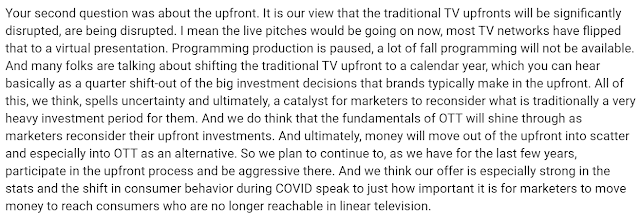
Both TTD and Roku talked about how failure of traditional TV "upfront" season can accelerate movement toward connected TV ("CTV").

Here's Roku in its 1Q20 call:


Here's TTD:

"Often, the majority of TV ads are sold in the upfront process. The upfronts are usually done in late April and early May, and those events are largely suspended this year."

"For advertisers, this can be liberating. I hear it from brands and agencies every day. For them, the upfronts are a bit of a burden. They're asked to commit billions of dollars to content they don't know that much about and chasing audiences that they can't measure quite as well as anywhere else. Now they have the freedom to be more deliberate, agile and data-driven in their TV ad investments."

That's an interesting point about advertisers not liking the upfront format. It reminds me of Bruce Greenwald's views of upfronts - as a scheme for media to collaborate against advertisers. 

"Behind the glitz is a highly successful, closely coordinated system to ensure the highest prices possible for advertising with the least incentive among networks to undercut one another."

"The up-front season occurs in the context of a general industry agreement on capacity developed under the guise of a public interest code of conduct to 'protect' viewers from too many advertisements...With the limited number of minutes available for sale preagreed, the tight time frames of the season make it relatively difficult for advertisers to successfully pit the networks against one another on price."
      - from "Curse of the Mogul" by Seave, Greenwald, and Knee


So traditional media is already declining, and now its implicitly anti-competitive/collaboration scheme is being exposed.

The question is what replaces the upfronts? Will there be another process that protects the bargaining power of publishers? Or does the leverage shift to ad buyers from now on?


CTV Now Exceeds Linear TV in Reach


I find it hard to believe but this is what TTD is saying. Jeff Green actually goes further and compares TTD alone to traditional TV!

"As I said, according to eMarketer, our total U.S. households with cable would fall below 82.9 million this year. Our research suggests it could be below 80 million. This year, we expect to reach well over 80 million households via CTV in the United States."

"This is an important point. The Trade Desk is the largest aggregator of CTV ad impressions across every major content provider, and that massive scale is a great leading indicator of future spend on our platform. All of this means that in 2020, The Trade Desk will likely surpass traditional TV in reach capabilities for the first time in our history. We're already seeing this shift as brands strategize on our platform."

Of course, larger reach does not mean larger monetization, but things are certainly looking bright for CTV. 

I don't like how TTD use the word "aggregator" to describe itself. It may be technically true, but broadcasting your ambition this way will likely make your clients wary and try to reign in your dominant position.


Strategic Role of Roku Channel, and CTV Fragmentation

In its quarterly letter, Roku mentioned that in the UK, the Roku Channel works on NOW TV (Sky) and Sky Q Devices.

Sky is part of Comcast which has Peacock. Peacock works on Roku. The Roku Channel works on certain Comcast devices. 

Are we going into a world where every channel works on every device, and the market for smart TV devices/software/platform gets commoditized? We now have Apple TV, Amazon Fire, Roku, Android TV (and its variants), Comcast Flex, Samsung smart TV, and it looks like XBox is getting into the game too. 

So where's the strategic point in the value chain? If CTV platforms like Roku and Apple TV become commodities, then the next point of aggregation are aggregate channels like Roku Channel, Peacock, Netflix, Hulu…etc. 

For Roku, there's a possible scenario where its importance in the value chain (and its profit potential) comes not from Roku the platform, but from Roku the Channel.

Monday, March 2, 2020

Notes on Trade Desk's 4Q19 Call

Trade Desk ("TTD") had its earnings call last week. Here are a few things that stood out to me.

On Connected TV ("CTV") trends:

1. CTV adopts header bidding style mechanism. See below:


2. Since walled gardens don’t exist in traditional TV, marketers see CTV as a chance to shift power away from the walled gardens.

3. Even live sports are adopting CTV.

Financial/Modeling Related

1. Take rates likely to come down over next few years. TTD talked about willing to give up some take rate for market share. This is likely to trigger competitive response.

2. Deleveraging on the sales/marketing costs over the next  few years as TTD add more employees to capture growth market. 
  • "you should expect sales and marketing to generally grow a little faster than revenue growth over the next few years"
3. Free cash flow suffered from massive working capital drain this quarter because the gap between DSO and DPO widened. It's not clear if that’s just temporary but management says they do want to bring it down.
  • I can see this cash drain being a problem as their agency clients might turn into bad credits. 
  • This also implies that some of that cash on balance sheet might not be excess as it is needed for working capital buffer.

4. 2020 revenue guidance implies deceleration through the year and exiting 4Q20 at mid/high 20's revenue growth. But management insinuated some sandbagging there
  • "we're more comfortable moving expectations up as we go"


Overall I think the results are solid, despite some of my cautions on financials above.

Since my September post the stock went up from ~$185 to now ~$280. It may looks expensive but that's because the company has years of profitable growth ahead - it is winning in a large TAM that's yet to be realized. 

How many companies are growing revenue 30%+ while having TTD's SaaS like margins and positive free cash flow? Not only that, the Trade Desk achieves this 30%+ revenue growth while spending a mere 20% of revenue on sales and marketing. This is a rare asset indeed.
  
I continue to hold TTD as a way to capture upside on the Connected TV theme.

Wednesday, January 29, 2020

CTV's "Walled Garden Risk" and Implications for Trade Desk

A few months ago I did a write-up about Trade Desk (TTD) here. That article focuses on TTD's upside and provide some context for this post. Here's a quick note on what I consider the biggest risk.

The long thesis is heavily predicated on the development of Connect TV (CTV) market, so any risk should focus on that area as well. Specifically, I'm watching out for any signs that the CTV market becomes vertically integrated walled gardens, which could shut out third parties like Trade Desk.

It is a somewhat theoretical concern. The idea is that a nascent industry needs vertical integration to maximize efficiency and work out the kinks, and that firms can "modularize" too early.

I wonder if CTV is that case. This is a risk not just for TTD, but for all independent 3rd parties like Telaria and Rubicon.

Are there in fact some advantages to vertical integration? There are signs the answer is yes. I'm just not sure how strong these advantages are and if they are enough to force the entire CTV industry to go walled garden.


Where Aggregation Happens, and Advantage of Integration

A couple discussion points below:

1. Here's an article on how Amazon has been pushing its SSP. This could be viewed either way. 

The negative take is that Amazon sees potential fragmentation coming to the CTV industry (not just Amazon Fire, Roku, Apple TV, Android TV but also players like Xbox, Samsung, Playstation, Comcast...etc). In case viewership fail to aggregate at the CTV platform level, Amazon wants to be able to aggregate them at the SSP level. 

As Amazon Publisher Services (APS) signs up more CTV platforms, this aggregation of eyeballs gives it negotiating leverage over ad buying platforms like TTD.

The article also indicates that Amazon's SSP is best used with Amazon's DSP. Whether Amazon extend that optimization to its partnership with TTD remains to be seen. Again, Amazon has the leverage here.

The positive take (for TTD) is if Amazon's SSP could be used on say Xbox or Playstation, that further shifts CTV industry away from walled garden approach. Also, APS actually allows ad buying from Trade Desk, so the more platforms APS hooks up with, the more TTD benefits.

2. Here's a discussion on advantages of vertical integration.

Basically the SSP can send data to some DSPs and not others. This would allow those DSPs to target better.


Signals of Changes in Industry Structure

The strongest CTV platforms are Roku, Amazon Fire, Apple TV and Android TV. Their decisions will determine the industry landscape.

For a while Amazon appeared to be going away from walled garden model with its deal with Trade Desk and Dataxu. But it recently dropped Dataxu after the Roku deal.That leaves TTD the only DSP capable of buying CTV ads on APS. This makes me wonder about Amazon's commitment to the open internet model.

The publishers have a say as well. It's important to know that Amazon's SSP actually owns only a portion of Fire TV ad inventory. As long as publishers can use their own SSPs, it's hard for the CTV industry to go totally walled garden. See comment on Reddit below:

TTD and DataXu are the only ones with access to Amazon fire inventory via Amazon SSP (or Amazon Publisher Services or whatever they call themselves these days). That makes up probably 20-30% of Amazon hardware CTV inventory. Publishers like Sling TV, Xumo, Pluto TV, etc., who have Amazon CTV apps still can sell that inventory via whichever SSP they choose to work with - SpotX, Telaria, FreeWheel, etc., and those SSPs offer access to DSPs other than TTD and DX

Source here


In conclusion, we need to watch out for 2 things on vertical integration: 1) Do CTV platforms allow publishers to use 3rd party SSP's?  2) Do those SSP allow 3rd party DSPs?

The answers to both have to be "no" for the industry to go "walled garden". So for now I think the probabilities are small.

If 3rd party SSP's like Telaria get bought out by a CTV platform, say Roku or Google, that would indicate a shift back toward walled garden, and be negative for TTD.

Monday, September 30, 2019

Trade Desk (TTD) Can Double: TAM Analysis and Valuation

I think the Trade Desk (TTD) can grow its revenue 5x in 5 years, and the stock can double.

Trade Desk is a Demand Side Platform (“DSP”) in the advertising world. The easiest way to describe TTD is via analogy. When you want to buy stocks you would log into a platform like Interactive Brokers, Fidelity or Schwab to put in your buy orders. These platforms would execute your orders by going to the stock exchanges (directly or indirectly), and you can keep track of your portfolio.

In the advertising world, agencies work on behalf of brands to buy ads from publishers. These agencies would use the Trade Desk’s platform to put in buy orders.

Here’s a simplified lay of the land:


Source here.

In the above diagram, Trade Desk takes the role of “DSP”, and transact in the market place. "Buy” and “sell” here refer to advertising inventories, so that anything from DSP and to the left is considered “buy side”, while anything from SSP and to the right is the “sell side”.


A Bull Market in Connected TV ("CTV")

The entire digital advertising space is undergoing expansion. Advertising has been steadily going digital the past decade, but a large budget for traditional TV ads remained.

That is being chipped away. Content that used to go on traditional TVs are all going online, first with Netflix, then HBO, Disney...etc. Smart TV boxes like Roku and Amazon Fire TV are accelerating that trend by aggregating content and making the user experience more convenient.

The most premium of these services like Netflix will be subscription based. But there is a long tail of contents that needs to go online, and many (if not most) of them will be funded with advertisements.

Ad buyers are increasingly seeing the benefit of CTV advertising - more precise ad placements, better customer experiences (frequency capping), better measures, more flexibility, and so on.

Roku’s streaming hours grew 72% yoy and its platform revenue grew 86% in the latest quarter. Telaria’s CTV business grew 133% yoy. Trade Desk saw CTV spend grew 2.5x yoy.

Now, that’s what I call a bull market!

All three companies mentioned above are buys in my opinion, with varying degrees of risks and rewards. I choose to focus on TTD here because I think it has the most visible future.

Roku is in land grab mode against Google and Amazon to embed its platform into smart TVs. Victory is far from assured given competitors' advantage in voice control technology. Telaria is a sell side platform, which is to say there’s about zero barrier to entry, since there’s always new publishers popping up. Also, a publisher may develop its own sell-side ad tech as it gets big (Opera is one such example). Ad revenues are central to the business of content owners after all.

The DSP's do not have this problem. Advertising spend is important to brands, but not so central to the business that brands would develop its own DSP – at least I have not heard of any such examples. In any case, brands mostly outsource to advertising agencies. There’s only a few of these (Omnicom, WPP, IPG, Publicis, Dentsu), and they have been using the Trade Desk.

Although I focus on CTV above, TTD will also benefit from other factors, including programmatic ad buying taking more share within digital advertising.

There are some moats here. There’s cross-side network effect where ad buyers want platforms that can access the most sell side inventories, and vice versa. In addition, there are only so many platforms that ad buyers would use, maybe one to three, and that’s it. (Go back to the stock buying example, how many brokerage platforms do you use?) It won’t be totally an oligopoly as switching costs and barriers to entry are not insurmountable, but industry structure should be fairly stable and concentrated in a few strong hands.

Trade Desk’s Market Position Within DSPs

Most agencies use 2-3 DSPs. As the “Usage” table below shows, it is basically platforms from Amazon, Google and TTD. Note that even though FB takes a lot of ad dollars they're not a DSP player.


Source: TTD Investor Day

TTD’s position looks even stronger if you consider that Amazon actually let Trade Desk bid on its CTV advertising inventories.

The other credible competitors are Adobe and MediaMath. I consider Adobe to be the bigger threat just from a sheer resource perspective, and I would note that Adobe is an “independent” that doesn’t own content/ad inventory, unlike Google or Amazon. This lack of conflict of interest gave TTD an edge over other platforms, and it might also give Adobe an edge.

We will have to factor in Adobe in the market share assumptions below.

Total Addressable Market analysis (U.S. only)

Note this analysis is U.S. only. I was going to do global but it turns out even just U.S. TAM supports a doubling of TTD’s share price. So I’m content using just U.S. TAM/revenues in my valuation while knowing there’s a huge international upside that I’m not factoring in. 

First, some facts:
  • Total U.S. ad spend $207bn in 2018; of which ~$106bn are digital ad spends and ~$60bn are TV ads. (See table below).
  • About 2/3 of digital ads go through Google and Facebook (“walled gardens”)
  • Only about $60 billion of ad spends are bought programmatically, but that number is growing fast.


Here’s a core assumption in my TAM estimate: eventually close to 100% of ad buying will be digital and programmatic (including programmatic direct which TTD supports). It just makes sense. I have not seen any evidence that this is not a safe bet.

I will also estimate TV and non-TV separately, since the former does not have the “walled garden” domination of Facebook and Google, and thus leaving more room for Trade Desk. Amazon’s opening up its CTV inventories is a strong signal that open internet will be the paradigm here.

So here’s my analysis of TAM/market share/and Trade Desk’s peak revenue, all in 2018 dollars.

1a): U.S. non-TV (~$107bn)
  • The big wall gardens like Google and Facebook own about 65-75% of this market. That leaves 25-35% of TAM for the open internet players, or ~$32bn.
  • DSP take rates of 15% (current take rate about 20% but I assume it will degrade over the years).
  • $4.8bn ($32bn* 15%) of potential revenues for Trade Desk and other DSPs to fight over.
1b) U.S. TV (~$60bn)
  • Again, I believe eventually all the ads will be digital and programmatic. No “walled garden” here.
  • DSP take rate of 10-15%. I assume a lower take rate here than non-TV because there are multiple layers of distribution and aggregation like Roku and Amazon Fire TV taking their cut already.
  • $6bn ($60 * 10%) of potential revenues for Trade Desk and other DSPs

2) TTD's market share and U.S. revenue?
  • Non-TV
    • 50/50 split between TTD and Adobe (remember this is assuming the walled gardens like Google and Facebook already took their share)
    • TTD's revenue = $2.4bn (half of the $4.8bn revenue for DSPs)
  • TV
    • Split between 5 DSP players: Amazon, Google, TTD, Adobe, and some others
    • TTD's revenue = $1.2bn ($6bn / 5)

Add up Non-TV and TV, I project TTD can eventually get to $3.6bn in revenue. The company will likely do ~$650mm of revenues for 2019. So at the current 40% revenue growth rate, TTD can get to this $3.6bn in 5 years.

There are multiple elements of conservatism in the above estimate:
  • I'm using 2018 dollars. 
  • Remember, that’s just the U.S. TTD is making a big effort to grow internationally, particularly in China, and I believe they will be successful.
  • I’m assuming TV ad market size stays the same even with various new innovations. The more realistic assumption would be to assume TAM expansion as technology drives down cost and improve access and adoption.
  • I'm not counting audio at all. This is a market that’s going through hyper-growth just like the CTV market.
  • The Walled Garden in non-TV advertising could come down due to regulatory pressures on Facebook and Google. This would instantly triple TTD’s opportunity in that area.

Stock Valuation and Upside

Take the $3.6bn revenue from above and apply 30% EBITDA margin and 20x EV/EBITDA (still plenty of growth runway in 5 years, strong market position, software margins…etc) get you ~21.5bn of enterprise value. Assume a little share dilution and stock is a double in 5 years for 15% IRR.

Risks

Take rates can come down to even lower than I modeled.