Resources

Showing posts with label financials. Show all posts

Sunday, June 14, 2020

PayPal's Move Into Offline Retail: Balance of Power Means Cooperation, Not Competition

I've been wondering about the payment value chain. Specifically how PayPal (and to some extent, Square) moving toward offline retail will shape the industry. Specifically, can its P2P apps aggregate consumer attention and lead to less industry power for Visa and Mastercard.

Today's consumer transaction landscape is as follows:
  • Peer to peer (P2P). PayPal and Square (with PayPal app, Venmo, and Cash App). Note that P2P transactions do not have to go through Visa and Mastercard's networks.
  • Business to consumer (B2C) online. 
    • Visa and Mastercard  - consumers puts in their credit card info online.
    • PayPal buttons.
  • Business to consumer (B2C) offline
    • Visa and Mastercard.
    • Apple Pay and Google Pay. These wallets mostly just wraps around credit/debit cards. 
    • PayPal and Square both have debit cards that consumers can put into Apple/Google Pay.
Note that PayPal already dominate P2P and have solid presence in B2C online, but weak in B2C offline.  


That's why I'm really interested in PayPal's initiatives to use QR codes. Here's a tweet back in February when I was thinking out loud:
 

My original thought process was something like this: 
  • The P2P apps (PayPal, Venmo, Cash app) already have ability to transfer money without going through V/MA. Brick and mortar retail is the missing piece before theses apps could be used anywhere.   
  • You can also store money in these PayPal/Venmo/Cash App. So these apps can technically replace banks and credit cards. 
  • The more transactions go through these apps, the more leverage they have. For example, if consumers rely on Venmo for all their transactions, including at retail stores, then Venmo can threaten to steer consumers away from V/MA's networks, and extract fee concessions. 


I've since updated my thinking. Why? Because if the above hypothesis is true, Google Pay and Apple Pay will be circumvented and rendered irrelevant. 

Is that realistic? Probably not. The payment space is so big that Apple and Google are unlikely to step aside without some competitive response.


The responses could come in 2 ways - co-op and retaliation. Google Pay and Apple Pay can easily co-opt the QR code movement by adding that features as well. The wallets can also retaliate by pushing into P2P space. In fact Google Pay already has P2P features but doesn't advertise it much. It's not very smooth now, but it works.

The payment sectors has a balance of power that prevents any one player from dominating. 

So what does PayPal really get out of this QR code move? I think it mostly furthers that balance of power - as if to say "hey Google/Apple/Visa/Mastercard, if you try to cut us out of the payment profit pool, we have the means to strike back."

It's building a bunch of nuclear warheads pointing at each other. Threat of mutual destruction upholds industry economics.

In the meantime, PayPal is broadcasting that they are open to cooperation, and not looking to cut any one out.

PayPal signals cooperation


I now think the multi-player landscape will hold and no one sub-sector or company will dominate. PayPal, Square, Apple, Google, Visa and Mastercard are frenemies that will cooperate instead of compete. They will collectively gain leverage over the banks.

With expensive growth stocks, the key is TAM and strategy. If the TAM is vast, as long as the strategy works, companies can grow into it. I think that describes both PayPal and Square. They are both long term buys.

Monday, February 17, 2020

FNF Diworsification (Acquisition of FGL)

On 2/7/2020, Fidelity National Financial ("FNF") announced that it is acquiring FGL Holdings (ticker "FG"), an index annuities provider.

I really do not like this deal.

The Stink of Life Insurance

In fact, I don't like anything that has a whiff of life insurance to it.

Life insurance and annuities are super long duration contracts and your P&L involves projecting out 20 years plus. That high level of of uncertainty means your financial statements are basically made up of layers and layers of assumptions (mortality/longevity, interest rates, equity index levels...etc).

This is why life insurance peers like Prudential (PRU), Metlife (MET), Lincoln (LNC) and so on all trade around 10x P/E. Don't let anyone tell you it's all about the low rates depressing investment income!

No, the very business model of life insurance and annuity is shit, period.

I would actually frown upon growth in this business, as growth would indicate the company is taking on more risk to bring in more business.

Now, I'll admit FGL's index annuities are less risky than the notorious variable annuities with guarantees. In those old GMDB/GMIB/GMDB products, policy holders invest in stock funds and the companies guarantee some minimum amount of return. These companies essentially sell a giant put option, exposing themselves to egregious losses during down markets. Index annuities, on the other hand, are newer derivative products (yes that's what it is). They are less risky because issuers essentially buy a bunch of call options on equity indices, and pass through the benefit to policy holders. Buying calls is less risky than selling puts!

A couple diagrams below show my understanding of how these products work. Notice that both the older GMxB and the new Index Annuities (FGL's products) give customers limited downside, but the latter incurs vastly better risk from insurer perspective.


So yes, FGL's annuities are much less risky than those notorious products of old. Still, over the life of a policy a lot of stuff can go wrong. FGL sells a derivative product with all sorts of market risks. I do not trust the financials.

Frankly, I doubt that FGL will ever shake off the stink of life insurance and the black box/ high risk stigma associated with it - even if rates go up. In other words, FGL will likely be a low multiple business forever. Even if it has high growth.


Is FNF Serious?

The first question is: is this actually a strategic acquisition, or it's just Bill Foley doing what he does - bring in some company only to spin it out later?

I told you above I hate the annuity business. So naturally, I hope it's the latter.

"Strategic acquisition" would be a big problem. As a shareholder, I don't want to see FNF deploy its abundant free cash flow toward growing a unrelated and shitty business that will never fetch a high multiple!

Unfortunately, the the 2/7/2020 conference call to discuss the acquisition seem to indicate otherwise. Management spoke of FGL as a strategic diversification and brought up examples of acquisition benefits, all of which are questionable.

As an example, they talk about FGL business smoothing out the combined company's exposure to interest rate changes. This is hogwash and they know it. FNF's refi business are already burned out from years of low rates and can't get hurt much more from higher rates. Also, it's not like FNF doesn't have its own investment operation that will benefit when rates go up!

Management also argued that FGL can benefit from FNF's bank relationship. In that very same call, FNF management actually backtracked from that assertion when challenged by analysts. The benefits will be limited to small time distributions.

I came away from the 2/7/2020 call feeling unsettled, but still hoping this is just Bill Foley playing the spin-off game.

Then came the 4Q19 earning call on 2/14/2020.

It Gets Worse!

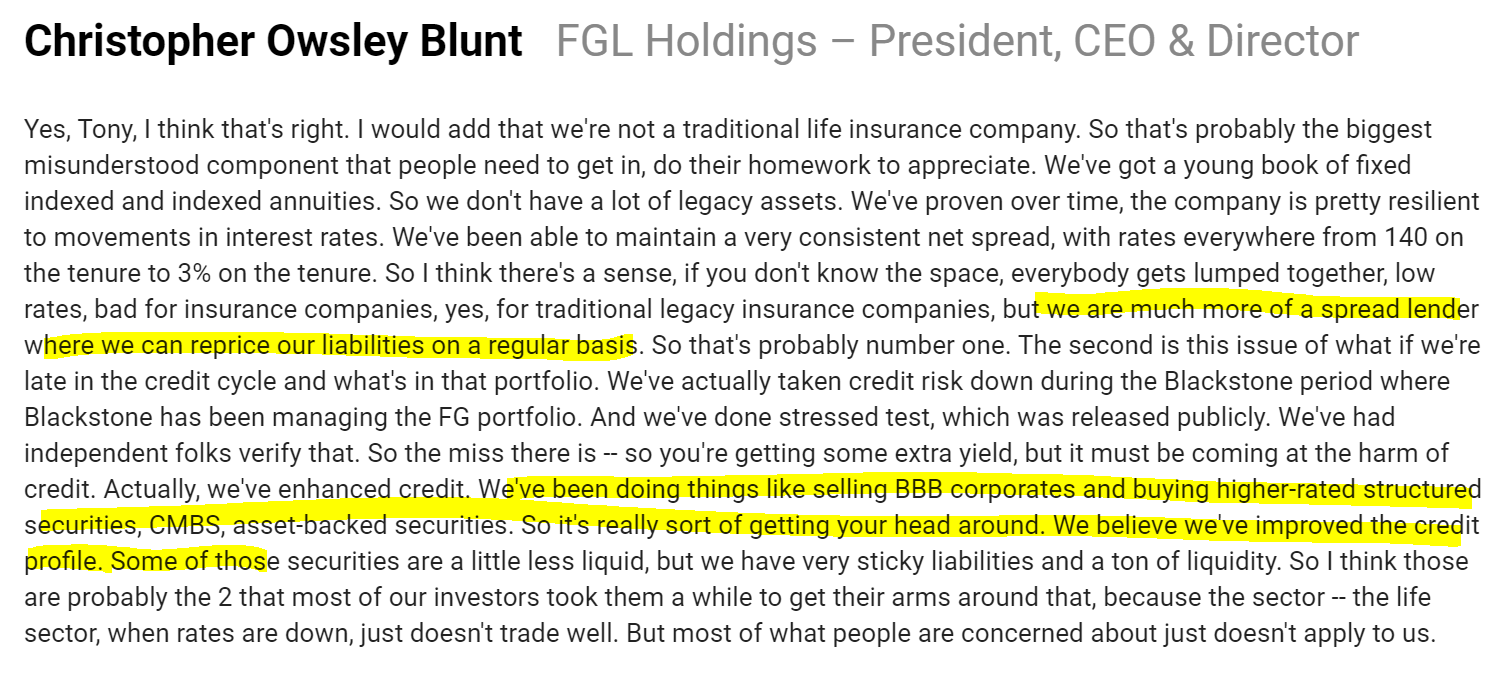
In the 4Q19 call, FGL's CEO Chris Blunt tried to address some of my concerns above and tried to argue that FGL is not quite a life insurance business. I think he failed.


The first point:
"We are much more of a spread lender where we can reprice our liabilities on a regular basis".
This is somewhat valid and very important. It corroborates my earlier point that index annuities are less risky than the older variable annuity products.

Repricing liabilities is important because that shortens the duration, making them less sensitive to key macroeconomic factors.

That lessens the pain but doesn't make it go away. I would rather the company NOT take on these liabilities at all! (per FGL's 10K for 2018, liability duration is ~6.2 years).

The second point about improving credit quality brings back nightmares. AAA rated CDO-squared anyone? After the 2008 debacle, how anyone can still equate credit rating with actual risk is beyond me.  

Some of my other notes from the 4Q19 call:
  • Talks about FGL doubling its AUM in 5 years with resource of FNF, could be 50% of FNF's overall earnings. (sounds awful!)
  • Apparently FGL has ambition in pension risk transfer. (PRT = WTF!!!)
  • Talks about giving Blackstone more money to manage. 
  • Talks about FGL increasing investment yield without compromising on risk - by switching from BBB corporates to higher rated ABS and CMBS.
Good Fucking God!

I even get the impression Bill Foley is looking at FGL's Chris Blunt as some sort of successor. The latter is not exactly young, But it's hard not to get that impression when Foley talk about FGL growing to 50% of overall company earnings, giving Chris Blunt more money to manage, and basically let Blunt talk nonsense like chasing yield with structured products and pension risk transfer.

FNF is like "yeah it's fine, it's just a spread business". First of all, that's suspect. Unlike your traditional bank lenders with exposure to rates and credit, FGL's business have exposure to rates, credit, equity, lapse rates, and longevity/mortality. It's a spread business in the generic sense that any business is a spread business because it has revenue and cost of goods sold.

Second, even if that's true, why would I trade a steady service business (which is what title insurance actually is) leading an oligopoly, with a "spread business" that has little entry barrier?

Conclusion

I suppose one can argue "of course Foley has to talk like it's a strategic acquisition, of course that's what he says now. Just wait a couple years and he'll spin it out, just watch".

Even if that's the case, FGL is not like FNF's past acquisitions. Black Knight, Ceridian...etc, these are growth companies that has a ready market when the time comes for exit. I don't see that for FGL - it's just not a high multiple business.

After several years of holding FNF (and as my largest position the past 2 years). I will have to exit or at least cut down drastically.

Thankfully it's a long weekend now. I will have time to sleep on it.


Tuesday, November 11, 2014

Genworth Valuation and Restructuring Considerations

Background & Summary
Genworth (GNW) took a dive last week due to long term care (LTC) concerns. The valuation looks absurdly low from a book value perspective. Is it a bargain? Here’s my take on it.
  • Sum of the parts analysis shows that GNW is trading within a range of fair value depending on where LTC comes out.
  • To realize the value here, GNW should restructure and cleanly separate the various mortgage insurance (MI) subsidiaries from the life insurance businesses (life insurance, annuities, and LTC).
  • However, GNW’s unique corporate and capital structure means that any restructuring would require paying down debt – the difficulties of doing so reduces upside from restructuring.


What Is It Worth

Here I did a sum of the part approach. I will intentionally leave LTC blank for now and come back later.  I get to about $9.5 per share excluding LTC. If we say US MI is probably worth more than I assigned here this thing could be worth $10-11+ excluding LTC.


·         Canada (MIC.TO) and Australia MI (GMA.AX) are valued using their respective stock prices and exchange rates.

·         Segments that do not earn its cost of capital (judged by ROE against tangible book) would certainly not deserve book value, so I used a normalized earning x multiple approach. This is unfortunately most of the businesses (US MI, Life insurance, fixed annuities, international protection)
·         “Normalized earnings” are basically taking average earnings for last 3-7 quarters and annualized. 
·         I’m probably underestimating US MI here. Earnings here should be growing due to legacy vintage losses running off. On the other hand, US MI will have to raise about $500-700mm of capital due to new regulations. Management plans to use reinsurance to meet that requirement and that would decrease earnings. The $1.2bn I assigned here is equivalent to 75% of tangible book value (ex AOCI and DAC)
·         Life insurance and fixed annuities earnings could be at risk. Genworth just got downgraded so that could hurt sales.
·         Use book value for runoff segment.
·         Corporate is basically net debt.  Netting $2.2bn of cash/investment against $500mm deferred tax liabilities and ~4.2bn of debt leaves ~- 2450mm of book value at corporate.
·         Why only ~$4.2mm of total debt vs $6.7bn total?  In segments that are valued using earnings, we implicitly netted out the debt already so we have to be careful not to double count. Interest expenses are already accounted for in Australia, Canada MI, Life Insurance (not including LTC), so those related debt are excluded here. 
·         I noticed that international protection segment has interest expenses allocated to it but I’m not sure which piece of debt that should be attributed to. So maybe I’m overestimating the debt in corporate segment, if that’s the case value would be even higher

An Ideal Restructuring

Let’s say LTC is not totally negative (a big assumption). At $8.5 / share GNW would seem undervalued. But how do we unlock this value? I attempted a stub trade: buy GNW, short Australia and Canada MI. Unfortunately my broker is telling me Australia MI is not available to short. (I’m just an individual investor and I bet a big time hedgie can get those share to short but even then international shorting surely have its own complications).

For shareholders to realize value, GNW should cleanly separate out the MI segments from Life insurance businesses. These businesses have little synergies between them (aside from financial ones which I will discuss next section). At this point, a highly specialized headache such as LTC would be better served by dedicated management and analyst attention.

On the other hand I’m not sure it’s possible to separate out life insurance between life, LTC, and annuities, as LTC is a capital hog. Those 3 will have to remain together in the near future.

Problem with Restructuring

A barrier to restructuring is the ~$4.2bn of debt at Genworth Holdings, Inc.  As seen in the corporate structure below, Genworth Holdings Inc is just a holding company and services its debt by 1) hoarding cash on hand, 2) subsidiaries to dividend upward. With life insurance subsidiaries not planning for dividends in the near future, Genworth will be even more dependent the various MI subs.

It’s fair to say any corporate break up would require paying down debt due to 1) rating concerns, 2) current reliance on mortgage subsidiaries for holdco debt service. 

However, companies don’t just get to pay down debt whenever they want. The bonds I looked at are all non-callable and make-whole premiums at T+30 would be very expensive. Tender-offers would also be tough as most bonds are still trading above par.

The valuation above already needs to be way above stock price for an activist to take on the black hole that is LTC, having the additional cost of retiring debt just makes it that much tougher.

Upside

That’s not to say a restructuring can’t be done. GNW can selectively retire some but not all of the bonds and optimize between debt service coverage, ratings, and costs.

Genworth has plenty of assets that can be converted into cash. Australia and Canada MI are already publicly traded so Genworth can sell more stakes. US MI should have plenty of bidders. Upstarts like ESNT and NMIH are better buyers than RDN/MTG due to their lack of legacy issues and thus capital needs. Also, I’m sure some banker is pitching AIG to combine United Guaranty with Genworth’s US MI and be spun off into its own company. Because GNW holds some cash cushion for debt service, deleveraging would itself free up some of that cash on hand.

Maybe if 4Q reserve reviews leaves capital in a good position and thus more visibility on the LTC end, management can start deleveraging and set the stage for restructuring. I'm not counting on it.

Simplified Corporate Structure


Capital Structure