Resources

Friday, February 28, 2020

Quantifying Illumina's Oncology Upside

Illumina ("ILMN") is the dominant provider of next generation sequencing (NGS) platform. The company provides an entire ecosystem of machines, consumables, software, and services. It's a bit of a razor and razorblade model, with sequencing consumables making up about 60% of revenue.

Analysts tend to worry about how many machines the company will sell this year and next year. I prefer to think in terms of end markets - after all, that is what drives instrument and consumable sales.

I will focus on oncology because I believe that will be the main contributor to the company doubling its revenue.

Oncology is not one, but three separate growth vectors. The three are 1) therapy selection, 2) monitoring, and 3) screening/testing. A couple slides from IR here give you a sense of relative market sizes.  The first is from Illumina, the second from Guardant Health.


The units are different, but we can tell that 1) all three are big markets, and 2) for now, therapy selection is the smallest but most penetrated market (and even then still very early innings); early screening is the largest but least mature market.

Let's think about how ILMN will participate in each of these markets.

1) Therapy selection. Precision medicine is revolutionizing medicine. Old medicine is a lot of trial and error - we don't really know how this drug treats this disease, but we know empirically (through clinical trials) that drug A is correlated with improvement in symptom B, so doctors prescribe it.

New medicine is different. We want to know what exactly is causing cancer. How does it impacts the specific patients in question? How will this specific patient react to this drug?

This is where DNA/RNA sequencing is required. Sequencing of patients' tumor samples allows us to move beyond some homogeneous view of cancer and into specifics of how the tumor works and how best to treat it.

That is the essence of companion diagnostics ("CDx"). CDx is in growth tornado mode and most, if not all, developers of these CDx does sequencing with Illumina machines. An example is Foundation Medicine which, through its parent Roche, has a partnership deal with Illumina to create more companion diagnostics.

Note that even companies who are skeptical of use of sequencing in early screening markets admit that sequencing makes sense for therapy selection. See below note from Exact Sciences (which uses PCR technology for screening, but think sequencing makes sense for therapy selection).


2) Monitoring. I believe the paradigm that prevails will work like Natera's Signatera (see diagram below).


Note that the process starts with sequencing of Tumor tissues. This is where Illumina's platform comes in. Natera would then use the data obtained from that step to create a personalized PCR assay, which is then used for on-going blood test monitoring (less invasive than requiring a solid tumor sample).


3)  Early Screening. I'm not convinced that sequencing will be required for this market and will (at least for now) not give credit to Illumina for this.

Screening is about testing for known diseases, for this PCR would do a cheaper and faster job. Cost of sequencing will likely come down a lot, so I think ultimately it comes down to the speed advantage of PCR.

I also get the sense that PCRs can be more distributed location wise. So instead of sending samples to some central lab for sequencing, it's faster to just have some sort of PCR at a location closer to patients.
To summarize this section, I believe Illumina's sequencing will 1) own the therapy selection market,  2) get parts of the economics in the monitoring market, and 3) get none of screening market (that's my assumption for now anyways).


Quantifying the Upside

So how do we quantify all of this for Illumina? My approach is figure out how much each of the 3 oncology vectors contribute to the company's consumables revenue right now, then scale those numbers up to some estimate of eventual market penetration.

From ILMN's 4Q19 transcript, we know that:

1) Oncology is about 20% of sequencing consumables.
2) Clinical versus research split is about 40%/60%.
3) Within oncology, therapy selection is by far the largest driver. Monitoring is nascent and screening is even earlier.
4) Oncology therapy selection is about 8% penetrated.

So if I take the $2.1bn of of sequencing consumable revenue in 2019, attribute 20% to oncology and 40% to research, that get us to $166mm of oncology clinical consumables revenue. I'll just assume all of that is therapy selection and $0 from monitoring and screening.

This $166mm is the basis of our analysis. I'm going to throw out some numbers just to demonstrating the thinking process and ball park the upside. The output is below.


Allow me to explain.

Ok, so $166mm of oncology treatment selection revenue for 2019. That market is about 8% penetrated now, where do we think it'll be in a few years? I'm assuming 60% here, so that scales up to $1,245mm of treatment/therapy selection revenue 5-10 years out (as shown in table above)

How about monitoring revenue? From the TAM presentation slides above, both Illumina and Guardant Health pegs the monitoring market at about 2.5x that of therapy selection. But remember, I think the Signatera paradigm (as explained above) will become standard, and Illumina only participates in the upfront sequencing and not the on-going monitoring.

Let's say 1/4 of the value from each monitoring treatment accrues to the sequencing platform provider - Illumina. (Plug in your own assumptions).

So my estimated monitoring revenue is the $1,245mm treatment selection revenue * 2.5 * 1/4 = $778mm.

I gave no credit to oncology screening opportunities, but that could change. Finally, for oncology research revenue I just take the present estimate of $249mm and give it a 3x to reflect the early inning nature of overall oncology market.

Layering in other assumptions for NIPT market and other sequencing consumbles, I can see Illumina's sequencing revenue go up to $7bn in a few years. The bulk of these gains come from oncology market shifting toward precision medicine and exploding upward.

Conclusions - about Valuation and Risks

The stock is around $270 at the time of this analysis. I get to about $2.5bn EBIT 5-7 years out and ILMN is thus trading at <15x EV/EBIT in years 5-7 (with interim cash flows lowering that EV). This is a decent price for what is essentially a monopoly that participate in growth markets.

The analysis here implies that Illumina's revenue will re-accelerate at some point - because the end markets will explode upwards.

Those revenues are Illumina's to lose, provided that the company retains its dominant competitive position. For now, Illumina is further entrenching its ecosystem by partnering with Roche and Qiagen to create 3rd party tests.

Risks

The only challenger on the horizon is Thermo Fisher with its Ion Torrent systems. There is also some small chance that the short-read nature of ILMN's machine could become a problem later. (Their failed deal with Pacific Biosciences would have given them strength in long-read market and remove this risk, but the deal failed).


Monday, February 17, 2020

Why Chipotle Stock (CMG) is So Expensive


I read Chipotle ("CMG")'s 10K for the first time the other day. Where have I been!

For years I have ignored the stock because of its very high multiples. I regret that very much. But better late than never.

Here I will share my notes. The 10 second summary is that Chipotle has decades of growth runway ahead of it, and it has not even started pulling some of the upside levers yet.

This is clearly a "buy every dip" stock.

Notes
  • Per store revenue and margin normalization - this has been going on the past few years.
    • "We are confident we can get back to volumes in the $2.5 million range, which is - those are the volumes we had just a few years ago."
    • "We think we can go beyond that. The idea that digital was only 5% or 6% of sales back in 2015 when we hit these peak volumes, digital is now at 18%. It's the fastest-growing part of our business. So we have assets today that we didn't have back when we were doing $2.5 million."

  • Margin expansion - increased digital sales drives operating leverage.
    • "Ultimately, long-term guidance, of course for AUVs and margins to rise in concert. 
    • Management has noted each incremental $100,000 in sales volumes translates into 100 basis points of restaurant margin. 
    • Chipotlanes. This is CMG's mobile pick up lanes. This requires a shift in real estate strategy as most of its current real estate is not end-caps but in-line sites. The newer restaurants make good candidates for Chipotlanes though.

  • US store expansion. They have about 2,600 stores, mostly in US. Management is confident that it can do 5,000 stores in U.S. I believe them.


  • International presence. Almost none right now!
    • They only have 39 international stores in Canada, Europe. 
    • CMG has no presence in Asia! From my own anecdotal observation, Chipotle will likely be hit among East Asian countries. I have personally observed people who pretty much only eat Asian food becoming big fans of Chipotle's burrito bowl. This is because those cultures are accustomed to rice based diets, and Chipotle's burrito bowl is a familiar format. 

  • Franchising. They are doing none of this and they don't need to. For now quality control is key so CMG should own the stores. Nevertheless franchising is something that can really juice ROE down the line.

  • No financial leverage. This is another lever that Chipotle can pull when it matures - perhaps 30 years later!


Chipotle is basically sitting on a gold mine, it just have to not mess up! As long as the company keeps up its quality and reputation (which management is carefully doing), the market is theirs to lose. Unlike the burger/pizza/fried chicken fast food market, Chipotle's market is vast with decades of runway ahead, and CMG dominates.

FNF Diworsification (Acquisition of FGL)

On 2/7/2020, Fidelity National Financial ("FNF") announced that it is acquiring FGL Holdings (ticker "FG"), an index annuities provider.

I really do not like this deal.

The Stink of Life Insurance

In fact, I don't like anything that has a whiff of life insurance to it.

Life insurance and annuities are super long duration contracts and your P&L involves projecting out 20 years plus. That high level of of uncertainty means your financial statements are basically made up of layers and layers of assumptions (mortality/longevity, interest rates, equity index levels...etc).

This is why life insurance peers like Prudential (PRU), Metlife (MET), Lincoln (LNC) and so on all trade around 10x P/E. Don't let anyone tell you it's all about the low rates depressing investment income!

No, the very business model of life insurance and annuity is shit, period.

I would actually frown upon growth in this business, as growth would indicate the company is taking on more risk to bring in more business.

Now, I'll admit FGL's index annuities are less risky than the notorious variable annuities with guarantees. In those old GMDB/GMIB/GMDB products, policy holders invest in stock funds and the companies guarantee some minimum amount of return. These companies essentially sell a giant put option, exposing themselves to egregious losses during down markets. Index annuities, on the other hand, are newer derivative products (yes that's what it is). They are less risky because issuers essentially buy a bunch of call options on equity indices, and pass through the benefit to policy holders. Buying calls is less risky than selling puts!

A couple diagrams below show my understanding of how these products work. Notice that both the older GMxB and the new Index Annuities (FGL's products) give customers limited downside, but the latter incurs vastly better risk from insurer perspective.


So yes, FGL's annuities are much less risky than those notorious products of old. Still, over the life of a policy a lot of stuff can go wrong. FGL sells a derivative product with all sorts of market risks. I do not trust the financials.

Frankly, I doubt that FGL will ever shake off the stink of life insurance and the black box/ high risk stigma associated with it - even if rates go up. In other words, FGL will likely be a low multiple business forever. Even if it has high growth.


Is FNF Serious?

The first question is: is this actually a strategic acquisition, or it's just Bill Foley doing what he does - bring in some company only to spin it out later?

I told you above I hate the annuity business. So naturally, I hope it's the latter.

"Strategic acquisition" would be a big problem. As a shareholder, I don't want to see FNF deploy its abundant free cash flow toward growing a unrelated and shitty business that will never fetch a high multiple!

Unfortunately, the the 2/7/2020 conference call to discuss the acquisition seem to indicate otherwise. Management spoke of FGL as a strategic diversification and brought up examples of acquisition benefits, all of which are questionable.

As an example, they talk about FGL business smoothing out the combined company's exposure to interest rate changes. This is hogwash and they know it. FNF's refi business are already burned out from years of low rates and can't get hurt much more from higher rates. Also, it's not like FNF doesn't have its own investment operation that will benefit when rates go up!

Management also argued that FGL can benefit from FNF's bank relationship. In that very same call, FNF management actually backtracked from that assertion when challenged by analysts. The benefits will be limited to small time distributions.

I came away from the 2/7/2020 call feeling unsettled, but still hoping this is just Bill Foley playing the spin-off game.

Then came the 4Q19 earning call on 2/14/2020.

It Gets Worse!

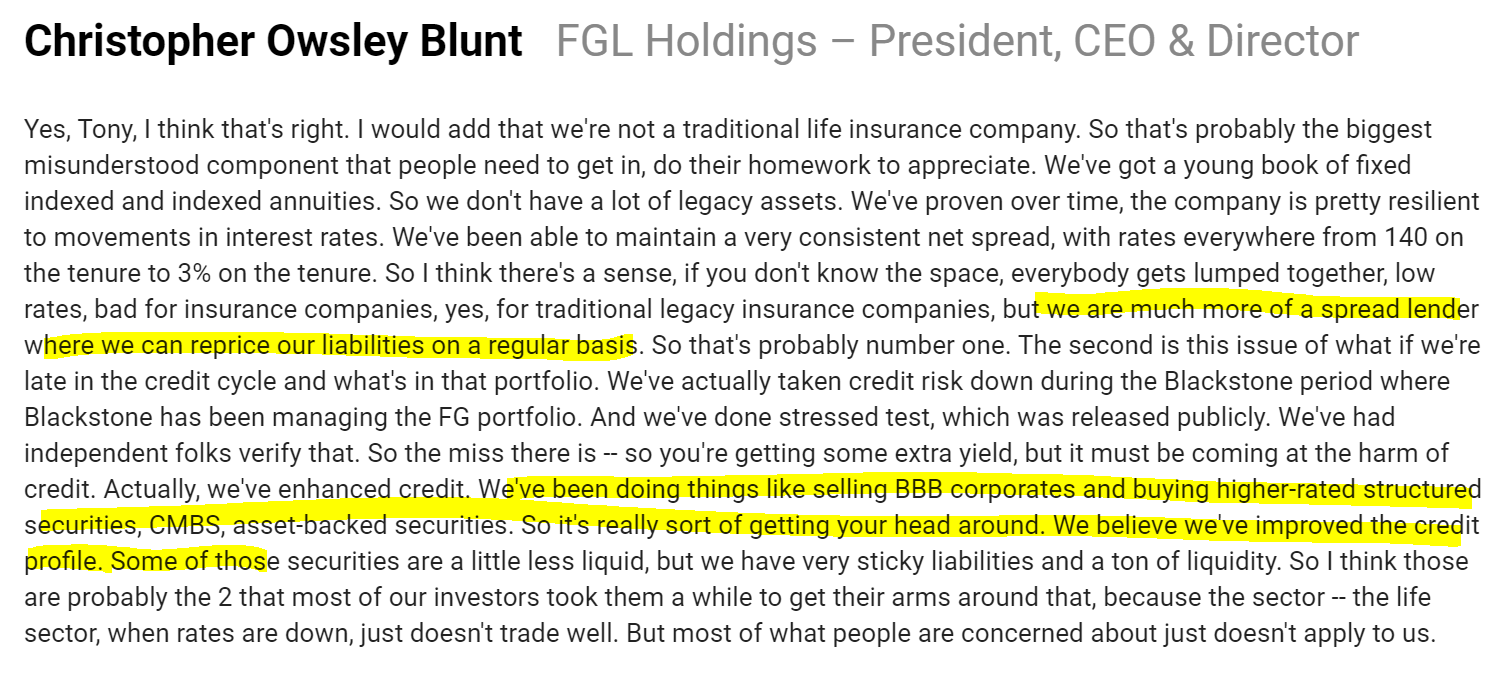
In the 4Q19 call, FGL's CEO Chris Blunt tried to address some of my concerns above and tried to argue that FGL is not quite a life insurance business. I think he failed.


The first point:
"We are much more of a spread lender where we can reprice our liabilities on a regular basis".
This is somewhat valid and very important. It corroborates my earlier point that index annuities are less risky than the older variable annuity products.

Repricing liabilities is important because that shortens the duration, making them less sensitive to key macroeconomic factors.

That lessens the pain but doesn't make it go away. I would rather the company NOT take on these liabilities at all! (per FGL's 10K for 2018, liability duration is ~6.2 years).

The second point about improving credit quality brings back nightmares. AAA rated CDO-squared anyone? After the 2008 debacle, how anyone can still equate credit rating with actual risk is beyond me.  

Some of my other notes from the 4Q19 call:
  • Talks about FGL doubling its AUM in 5 years with resource of FNF, could be 50% of FNF's overall earnings. (sounds awful!)
  • Apparently FGL has ambition in pension risk transfer. (PRT = WTF!!!)
  • Talks about giving Blackstone more money to manage. 
  • Talks about FGL increasing investment yield without compromising on risk - by switching from BBB corporates to higher rated ABS and CMBS.
Good Fucking God!

I even get the impression Bill Foley is looking at FGL's Chris Blunt as some sort of successor. The latter is not exactly young, But it's hard not to get that impression when Foley talk about FGL growing to 50% of overall company earnings, giving Chris Blunt more money to manage, and basically let Blunt talk nonsense like chasing yield with structured products and pension risk transfer.

FNF is like "yeah it's fine, it's just a spread business". First of all, that's suspect. Unlike your traditional bank lenders with exposure to rates and credit, FGL's business have exposure to rates, credit, equity, lapse rates, and longevity/mortality. It's a spread business in the generic sense that any business is a spread business because it has revenue and cost of goods sold.

Second, even if that's true, why would I trade a steady service business (which is what title insurance actually is) leading an oligopoly, with a "spread business" that has little entry barrier?

Conclusion

I suppose one can argue "of course Foley has to talk like it's a strategic acquisition, of course that's what he says now. Just wait a couple years and he'll spin it out, just watch".

Even if that's the case, FGL is not like FNF's past acquisitions. Black Knight, Ceridian...etc, these are growth companies that has a ready market when the time comes for exit. I don't see that for FGL - it's just not a high multiple business.

After several years of holding FNF (and as my largest position the past 2 years). I will have to exit or at least cut down drastically.

Thankfully it's a long weekend now. I will have time to sleep on it.


Wednesday, January 29, 2020

CTV's "Walled Garden Risk" and Implications for Trade Desk

A few months ago I did a write-up about Trade Desk (TTD) here. That article focuses on TTD's upside and provide some context for this post. Here's a quick note on what I consider the biggest risk.

The long thesis is heavily predicated on the development of Connect TV (CTV) market, so any risk should focus on that area as well. Specifically, I'm watching out for any signs that the CTV market becomes vertically integrated walled gardens, which could shut out third parties like Trade Desk.

It is a somewhat theoretical concern. The idea is that a nascent industry needs vertical integration to maximize efficiency and work out the kinks, and that firms can "modularize" too early.

I wonder if CTV is that case. This is a risk not just for TTD, but for all independent 3rd parties like Telaria and Rubicon.

Are there in fact some advantages to vertical integration? There are signs the answer is yes. I'm just not sure how strong these advantages are and if they are enough to force the entire CTV industry to go walled garden.


Where Aggregation Happens, and Advantage of Integration

A couple discussion points below:

1. Here's an article on how Amazon has been pushing its SSP. This could be viewed either way. 

The negative take is that Amazon sees potential fragmentation coming to the CTV industry (not just Amazon Fire, Roku, Apple TV, Android TV but also players like Xbox, Samsung, Playstation, Comcast...etc). In case viewership fail to aggregate at the CTV platform level, Amazon wants to be able to aggregate them at the SSP level. 

As Amazon Publisher Services (APS) signs up more CTV platforms, this aggregation of eyeballs gives it negotiating leverage over ad buying platforms like TTD.

The article also indicates that Amazon's SSP is best used with Amazon's DSP. Whether Amazon extend that optimization to its partnership with TTD remains to be seen. Again, Amazon has the leverage here.

The positive take (for TTD) is if Amazon's SSP could be used on say Xbox or Playstation, that further shifts CTV industry away from walled garden approach. Also, APS actually allows ad buying from Trade Desk, so the more platforms APS hooks up with, the more TTD benefits.

2. Here's a discussion on advantages of vertical integration.

Basically the SSP can send data to some DSPs and not others. This would allow those DSPs to target better.


Signals of Changes in Industry Structure

The strongest CTV platforms are Roku, Amazon Fire, Apple TV and Android TV. Their decisions will determine the industry landscape.

For a while Amazon appeared to be going away from walled garden model with its deal with Trade Desk and Dataxu. But it recently dropped Dataxu after the Roku deal.That leaves TTD the only DSP capable of buying CTV ads on APS. This makes me wonder about Amazon's commitment to the open internet model.

The publishers have a say as well. It's important to know that Amazon's SSP actually owns only a portion of Fire TV ad inventory. As long as publishers can use their own SSPs, it's hard for the CTV industry to go totally walled garden. See comment on Reddit below:

TTD and DataXu are the only ones with access to Amazon fire inventory via Amazon SSP (or Amazon Publisher Services or whatever they call themselves these days). That makes up probably 20-30% of Amazon hardware CTV inventory. Publishers like Sling TV, Xumo, Pluto TV, etc., who have Amazon CTV apps still can sell that inventory via whichever SSP they choose to work with - SpotX, Telaria, FreeWheel, etc., and those SSPs offer access to DSPs other than TTD and DX

Source here


In conclusion, we need to watch out for 2 things on vertical integration: 1) Do CTV platforms allow publishers to use 3rd party SSP's?  2) Do those SSP allow 3rd party DSPs?

The answers to both have to be "no" for the industry to go "walled garden". So for now I think the probabilities are small.

If 3rd party SSP's like Telaria get bought out by a CTV platform, say Roku or Google, that would indicate a shift back toward walled garden, and be negative for TTD.

Experiment

I'm going to do an experiment. 

I got a list of companies from $1bn to $10bn market cap, growing revenue >20% a year with decent gross margins (>20%). The objective is to look for stocks that has potential to go up 3x or greater within that universe.

I ran a screen from Fidelity. The result is about 185 names and I will commit to knowing each of them over the next 2 months. So going over 3-5 companies a day would do.

This should be very feasible. I probably know some of these companies already. The challenge is to go through them with a fresh set of eyes and abandon any preconceived notion, ("Wayfair?!  that's a no!"), and really try to think big about what the upsides are for each.

A year from now I'll see how many home runs I missed.

Maybe there will be 0 home runs out of these 185 companies. That's possible too. But I'll try to get as many as I can.

I would love it if someone wants to join me in this effort. If you would like to help, please reach out in the comments or DM me on Twitter.  Thanks!

Monday, January 20, 2020

Funko - Quick Flip Ok, Not Long Term Investment

At $15.6/share and 12x PE, Funko (FNKO) is cheap enough that I wouldn't mind buying it for a quick flip. But I do not see this as an investment to hold for the long run. This article explains why. (hint: one of the themes I have been exploring is an "overfit" between a firm's competitive advantages and its markets)


Funko make pop culture figures like these.

Contrary to what you might think, Funko's target audience is not children.
Our demographic is a 35-year-old, 50% male 50% female who is buying our products for themselves, not for other people, for no special occasion. And I said that could not be more -- any further from who is in the toy aisle buying a present for a kid for their birthday party or for Christmas. 

Regardless, Funko's product is an affordable luxury. No one NEEDS this stuff. But they just want it. I'm not sure I'd call it a fad - the big headed style is a niche that has always existed, even before Funko - but revenue growth clearly has a large cyclical component to it and can easily fizzle out.

What's more interesting is Funko's value proposition to IP owners. Funko helps them keep contents relevant, in view at stores and in conversations. Often the contents are hit driven and content owners want to keep the conversation going between hits. An example would be Marvel superhero movies. Marvel built a franchise of inter-related characters, but there's significant downtime in between movie releases. Funko figures is one of many ways to keep those characters in consumer mindshare.


Barrier to Entry

Making pop culture figures is obviously not rocket science. Nevertheless, there are some barrier to entry and I'll list them out.
  • Relationship with content owners. This is not easy for anyone to come in and replace.
  • Process advantages. Funko have a group of creative people who are great at detecting pop culture trends and come out with product quickly.
  • Retail distribution relationships. 

Funko's Place In IP Monetization Chain

I would say relationship with content owners is the most important one. In the grand scheme of things though, Funko is just one small part of the content monetization value chain.

Below is a little diagram I drew up.


IP is at the bottom of everything. The second layer in the diagram shows monetization schemes such as movies, theme parks, toys, T-shirts..etc. In this example, Disney (inside the dotted line) owns various IP and produces movies and theme parks, but outsources the production of toys and t-shirts to third parties. Funko (and Hasbro and others) monetizes for Disney in the toy category, and has relationship with distributors and retailers.

Who has negotiating leverage here? I would say it's clearly the content owner and not Funko, since 1) Funko's products are not the only to monetize IP,  2) it's often a minor revenue stream for content owners.

Perhaps due to this lack of bargaining power, Funko's licenses are usually not exclusive even within the toy category (for example Hasbro and Funko both have Mandalorian products). This further dilutes Funko's bargaining power.

I can also easily think of scenarios where, in order to access the hottest character licenses, Funko has to pay for a bundle that includes far less marketable characters. Effectively they would have to pay premium for what they want.

In short, Funko's relationship with content owners enables its business model, but will also limit its upside in terms of margins.


Process Advantages

As far as process advantages go, here are a few excerpts from transcripts that stood out to me:
  • Low start up cost
  • Absolutely. So for us to develop a new SKU, it really costs us between $5,000 and $7,500, which means I really only have to sell about 2,500 units or so in order to just break even. And that gives us a lot of flexibility to look at niche properties, niche licenses that we can go after and then see how they resonate. It allows us to be very authentic, which is important to us in terms of connecting with that end consumer and casting that wide range.
  • And a great example of that is we saw some tailwinds or whisperings around Bob Ross a year or so ago. And so we called up the licensor and said hey, we want to sign up the license. It was a $5,000 minimum guarantee. The licensor is like, well, how many units do you think you are going to sell? And we were like, well, it's really hard for us to sell fewer than 20,000 to 30,000 of anything that we put out there.
  • We announced it; it caught fire from a social media perspective. It ended up with an end cap at Target. And before the product was even manufactured, we had presold something like 600,000 or 650,000 units.
  • Agility
    • (regarding Game of Thrones) That was on a Sunday night. By Wednesday, we had that item digitally sculpted and colorized and were pre-selling it online and sold several hundreds of thousands of units to fans. And everyone said, oh, you must have known that was coming. We had no idea.

Low startup costs and agility both reinforce Funko's long tail of minor/niche characters; and as such they are inter-related.

The low startup costs (and thus low breakeven) means Funko has the flexibility to experiment with new ideas and take risks. Agility means if said idea does not work, Funko can quickly shift to another idea, keeping its opportunity costs low. Both helps Funko cover maximal ground with minimal monetary and opportunity costs - important if your market is long-tailed in nature.

Agility also ties in to relationship with IP owners as well as distributors. After all, putting out a product in 3 days requires high degree of coordination - both upstream and downstream.

So it seems Funko's process advantages are highly suitable for its specific market. Not only that, they are related to other moats, which makes the sum greater than its parts and thus hard to duplicate.


Conclusion - Investor Perspective

The questions is how scalable these advantages are beyond the niche of pop culture figures. If these figures turns out to be a fad and consumer interests fizzle out..would Funko be able to take these resources and processes and do well in another market? Is there even another market that fits so well to Funko's advantages? What would that be? Clothes? Bags? Games? Fashion?

If yes, the stock could be a multi-bagger. If not, the stock will languish in mediocrity. For now, I think it's the latter.

Funko clearly has competitive advantages that will allow it to dominate its particular niche. But 1) the sustainability of this niche is questionable, 2) the IP relationships weigh on margins, and 3) the competitive advantages are so tailored to the specific market that I'm not sure they can scale to another market easily.

Funko is still growing fast (the company plans to more than double its EBITDA in a few years). But it is unlikely to get a high multiple for reasons above.

Friday, January 10, 2020

Changes I Hope to Make to This Blog

Happy New Years! There are some changes to the blog I hope to make this year. They are based on why I write and what I want to get out it.


Why I Write

I had a few objectives in mind when I started writing this blog a few years ago:
  • Keep track of my own ideas and evolution as an investor.
  • Facilitate discussion to get feedback and sharpen investment ideas.
  • Discipline. I’m a full time, individual investor. While that freedom is great, I want to have some sort of weekly deliverable to impose discipline and focus on myself. The blog is that "deliverable".

How did that work out the past few years?

This blog is only ok as a place to track my own ideas. I'd write maybe one post for every 30 ideas I explore. That’s because most ideas were filtered out pretty quickly as not worth my time. And increasingly I'm writing posts that have no definite buy or sell implications.

The "facilitating discussion" objective completely failed. I have not gained any sort of consistent readership, and that means no feedbacks for my posts. Instead I've discovered Twitter, which has served that purpose wonderfully.

The “discipline” objective sort of worked. Although I’m not posting on a weekly basis as originally intended. One reason is as mentioned above- most ideas I explore are not worth a deep dive. In any case, much of investment research revolves creating a hypothesis and disproving them. I’m not sure presenting all these failed hypothesis makes for good blog content. The other reason is I’m not a good writer, and turning my existing notes (primarily in bullet points) into paragraph format takes a lot of time. That’s time detracted from my research and investment activities.


Changes

I think a few changes can address these issues.

First, aim for smaller but more frequent posts. 

I’m thinking like avc.com where a post can just be a couple hundred words and a simple observation. So the blog would be more like a journal where I just record whatever I learned, instead of feeling like I have to write a complete buy/sell thesis on a specific stock.

I'm already posting on Twitter just about every day, so a lot of blog posts this will be elaborations of those same tweets.

Second, I want to try out new formats, particularly videos. I keep a ton of notes during research, but they are in bullet points and it's time consuming to turn them into paragraph/blog format. It may actually be easier to post a video where I show a couple powerpoint slides and just talk through them.

Comments are welcome!